Monday, July 15, 2013

Goods En Route: Casio MTP1183E-7A Watch


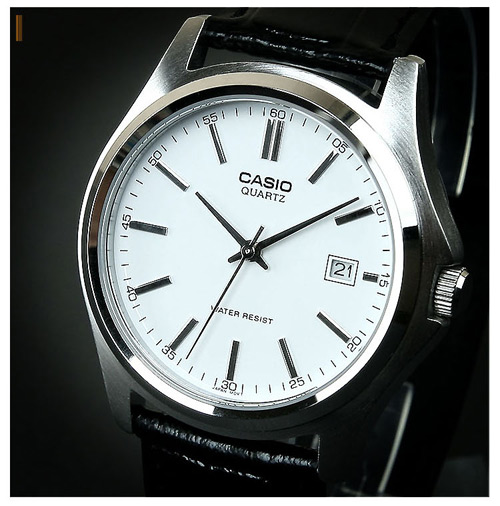
My latest acquisition from Amazon:  a new contender for the title of "Best Watch Under $25."  This Casio MTP1183E-7A seems to have all of the design elements down, and from the higher resolution images I've found online, appears to offer a fit and finish far above its price point.  Will it overthrow the Timex Weekender as the best bang-for-buck analog on Amazon?  Stay tuned to find out.

Monday, June 24, 2013

It's On Amazon: Ultra-Pro Pro 4-Card Binder


One of my ongoing organizational challenges is - as I'm sure many collectible card game (CCG) players encounter - is managing my collection in a way that allows me to have ready access to the cards that I might need to assemble a deck on short notice.  One limiting factor is that several deck designs may require the same playset of cards (in Magic: The Gathering (MTG), four copies); so long as one deck is built, the other has to remain in a perpetual state of incompleteness, until the missing cards can be swapped from one deck to another.  This is an acceptable complication when two decks are involved, but when the decks multiply this musical chairs exercise can make it easy to forget where a particular set of cards ended up last.

The simplest solution would be to obtain as many playsets as needed; becomes unfeasible, however, when the cards in question cost as much as $50 a copy, as the hottest staples in Standard sometimes do.  I've attempted to use card binders to give a bit more organization to the cards that every deck seems to need, but splitting four-card playsets across nine-card pages makes for uncomfortable and nigh untrackable splits between playsets.

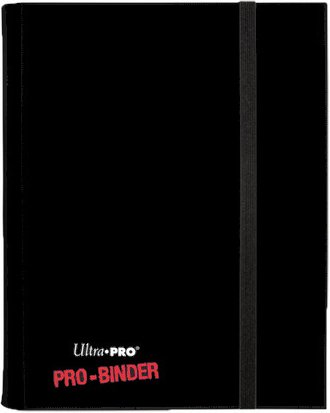
The solution I've come up with is a series of four-cards-per-page binders by Ultra-Pro called "Pro Binders." These are Ultra-Pro's take on the popular Monster Binder series, which use side-loading slots and textured back surfaces to ensure that cards don't slip out of position in transit.  In my opinion, Ultra-Pro improves on Monster's design by allowing more play in each slot, so that sleeved cards of MTG size fit comfortably, and both sides of a page can be utilized without over-stuffing the binder.

If you collect and/or play a CCG that uses an up-to-four-copies deck construction rule like MTG, the four-card Pro Binder might be a practical solution to keeping deck staples readily on hand.  For those CCGs that use different construction rules, or for those that prefer the more traditional nine-card-per-page binder format, Ultra-Pro also makes Pro Binders in a nine-page format.  I use them to store the vestiges of my older CCG collections - Star Trek, Star Wars, Battletech, etc. - and I find them preferable for cards that won't be called to deck duty anytime soon.

Monday, June 17, 2013

Keyboard Review: Leopold FC660M (Cherry MX Red Switches)

So, hot off the heels of my ecstatic experience with the FC660C, I decided to check out the FC660M, which is the same 60% Leopold keyboard, but with Cherry MX Red switches.  In my mind, the result would be a FC660C with a seemingly lighter actuation force, which is how the Reds in my Majestouch 2 Tenkeyless feel.  Less than a week later, having received the FC660M from a reputable eBay seller, I found the reality to be somewhat different.

To start off with, the C and M models have a few more differences than the keyswitches they use.  The keycaps on the FC660C are virtually identical in shape, texture, and color to the black keycaps from my Realforce 87U.  The FC660M's are markedly different.  They feel flatter when typed on, as they don't cradle the pads of your fingers the way that the Topre-style keycaps do.  Also, for some reason the normal-sized Windows key on the FC660C is swapped out on the FC660M for a 1x-sized key with a keyboard pictograph.  The DIP switches, along with the USB Mini-B ports are also located in different spots on the C and M models.

The result is that despite its virtually identical layout, the FC660M feels like a vastly different keyboard from the FC660C.  For someone who absolutely fell in love with all aspects of the FC660C, this results in a measurable degree of disappointment.  Worse yet, for someone who likes the feather-light actuation that Reds can provide, the Red switches on the FC660M feel heavier than the Reds I've used on Filco boards.  I'd almost say it feels stiffer than the Topre switches on the FC660M, and without the benefit of the Topre's snappiness, the result feels clumsier and unresponsive.

I planned to take advantage of the seller's generous return policy, until I realized that return shipping back to China would take a $30+ chunk out of that refund.  Instead, I've posted it to eBay so that I can recoup a bit more of my investment and someone else can snag a brand new (minus a few test sentences) FC660M for less than the going rate among Chinese sellers.

Before plunking down for the FC660M, I was torn between it and the Filco Minila.  I went with the FC660M because of my satisfaction with the FC660C, but now I wonder if I should try the Minila to see how I like Filco's Reds in a compact format.  It's even possible that I might prefer the Minila's layout - particularly its dual function keys - to the FC660C's.  Only time - and this blog! - will tell if I recoup some of my FC660M investment and use it toward giving the Minila a try.

Monday, June 10, 2013

Keyboard Review: Leopold FC660C (Topre Capacitive Switches)


I seem to have the devil's own luck when it comes to keyboards.  (Whether that is a good or bad thing, though, is open to debate.)  Several years ago, I managed to snag one of the limited edition Filco tenkeyless keyboards with Cherry MX Red switches back when reds were very hard to come by.  I did so by happening upon the Amazon link only hours before fellow enthusiasts at GeekHack.org and other internet forums swarmed in and emptied Keyboard Co.'s stock on Amazon.  Likewise, after nearly a year-long hiatus from acquiring new keyboards, a chance visit to GeekHack a few weeks ago led me to discover that Leopold had released a 60% (66-key) mini keyboard using Topre capacitive switches called the FC660C, and that it had been stocked by EliteKeyboards.com.  Having learned my lesson from Cherry Red Filco all those years ago, I purchased one before it could go out of stock - which it did a few days later.

My main reason for picking up the FC660C was the interesting layout.  It occupies the middle ground between standard tenkeyless and compact keyboards like the Happy Hacking Keyboard, in that it includes dedicated directional buttons and a two-button island for the Insert and Delete keys.  As I usually remap my Insert key to open up My Computer, this unique layout seemed custom-made for my purposes.  While I occasionally miss having dedicated Page Up and Page Down buttons, the Function button is situated close enough to those keys that I quickly picked up the two-button combinations.  The only maneuver I can't perform on the FC660C that I used to on a tenkeyless is a two-finger Alt-F4, which requires two hands now  due to the wide space between the Function and F4 buttons.

I'm not sure why, but the FC660C's switches feel snappier than those on my Realforce 87U and HHKB2 Pro.  Others who have reviewed the keyboard on GeekHack have expressed similar impressions.  That, added to the solid sub-$200 price (a relative bargain when it comes to Topre switches), makes the FC660C a very attractive introduction to the world of capacitive switches.

While the FC660C has been elevated to my favorite capacitive switch keyboard, I'm still on the fence in comparing it to my previous favorite switch, the Cherry MX Red.  I decided to settle matters by purchasing a FC660M with Reds on eBay.  When it arrives, with all else being equal, I should be able to compare the switches themselves to come up with a clear determination.

Monday, June 3, 2013

Goods Resource - Keyboards: GeekHack.org


This inaugural post in the "Goods Resource" series features the forum community that taught me more about mechanical keyboards than I could have imagined when I was first exposed to Filco Majestouch models at Cleverly 2 in Akihabara:  GeekHack.

The GeekHack forums are where you can take the pulse of the online English-speaking mechanical keyboard enthusiast community.  You can learn what distinguishes the various colors of Cherry and Alps-branded keyswitches, or what makes Topre capacitive keyswitches better than standard membrane switches (despite the incorporation of a rubber dome in their design).  You can see what latest models from the Far East (China, Korea, and Japan being the biggest players and markets in the mechanical keyboard industry) are attracting attention and depleting wallets.  Having been out of the keyboard game for a while, I learned from my last visit to GeekHack that several U.S. or U.S.-accessible companies (Cool Master, Keycool, etc.) have entered the game.  Cool Master is particularly interesting, as they use the same manufacturer for their boards as Filco - Costar - but offer their products at roughly 2/3rds the price.  Cool Master also is the only player in the market that currently offers a tenkeyless board with Cherry MX Green keyswitches (the CM Storm QuickFire Rapid), which is reputed to be as close to buckling spring tactility as Cherry has been able to achieve.  I currently have one on order at Amazon.

That's the dual perk and peril of visiting GeekHack:  you come away with more knowledge in your head (and a potentially better typing experience at your fingertips), but less money in your wallet.

Monday, May 27, 2013

It's On Amazon: V-MODA Crossfade M-100 Over-Ear Headphones

I've had several contenders in my quest for my perfect set of headphones:  AiAiAi TMA-1s and TMA-1 Studio (the former now eBay'd; the latter returned), California Headphone Company Silverados (my current work headphones), and Audio-Technica ATH-M50s (returned due to sibilance with my PC's stock audio - it might have done better with a FiiO E17 "Aspen" portable amp / DAC).  The current titleholder is V-MODA's M-100, a stylish, durable, and well-designed set of cans that, for me at least, hits the headphone sweet spot.

The first criterion in my headphone search was the over-ear form factor; I'd learned from the TMA-1s that on-ear is often less than comfortable for prolonged listening or gaming sessions.  This was the TMA-1 Studio's Achilles heel:  neither set of earpads made for a comfortable seal that at the same time preserved audio fidelity.  The ATH-M50's earcups were so shallow that wearing them felt like donning an oversized on-the-ear headset.  The CHC Silverado is perhaps the most comfortable headset I've owned - with spacious earpads that full encompass my ears - but their audio quality is middling at best.  So it was with lessons learned from these $100-$250 cans that I searched for a new mainstay set.

Consulting fora like Head-Fi.org, I eventually narrowed the field down to two contenders:  the Sennheiser Momentum and the V-MODA M-100.  The headphones' respective sound profiles lead me to lean toward the Momentum at first - I've liked Sennheiser's sound in the past and have never been much of a bass head - but a review from Tyll Herstens of InnerFidelity lead me to the conclusion that the Momentum's smaller earpads might leave me with the same crushed-lobe fit that made the ATH-M50 a nonstarter.   That, coupled with Tyll's enthusiastic treatment of the M-100 led me to purchase a pair from Amazon.

The $20 (and free shipping) that I saved quickly evaporated when I discovered that the M-100, much like the M-80 on-ear model, had the option of swapping out the stock "shields" for custom colors and engraved monotone images.  This option is included free with a direct purchase from V-MODA, but is also available for purchase separately for $45.  With my set already en-route, I laid down the extra cash, uploading one of my character sketches for the engraved design.  I think it turned out pretty well:


Aesthetics is definitely a factor in considering the M-100.  It incorporates V-MODA's signature hexagonal design, which is a subtle touch that doesn't hit you over the head with its uniqueness; it's there if you care to take note of it, but doesn't get in the way of the M-100's performance.  Materials are solid and feel well built, if not quite to battleship-like metal-and-leather-only specs of the CHC Silverado.  Finishing, though, is a touch above any other headphone I've owned.  A great example of the M-100's fusion of sleek design and solid functionality is in the hinge mechanism that allows you to fold the headphone into a more compact shape for travel.  The hinge could have easily been a structural Achilles' heel if not done right; instead, it's both sleek and sturdy, giving you the impression that other parts of the M-100 - such as the cord (which is removable and replaceable) - will wear away long before it will.

The M-100 comes with two cords of differing length; one is a 3-foot cord with built-in cellphone mic, the other is a 6-foot cord with a built-in audio splitter.  For me, these two cords are purpose-built for the two primary uses I have for my headphones:  as a set of cans for portable media devices like my cellphone and tablet, and a gaming / media headset for my desktop PC.  The mic on the shorter cord means I can answer calls while wearing the M-100, or even use it as a dedicated hands-free option.  The splitter on the longer cord allows me to keep the M-100 and my desktop speaker plugged in concurrently, eliminating the need to swap between the two as the need arises.

All these amenities are useful, but the ultimate criterion of any set of headphones is, of course, how they sound.  Compared to the "dark" profiles of the two AiAiAi TMA-1s, what I found to be an overly sibilant treble on the ATH-M50, and the OK-but-not-great sound of the Silverado, the M-100's sound profile is like a breath of crisp fresh air.  The added bass doesn't inhibit a non-bass-head's enjoyment; if anything, I'd agree with InnerFidelity's assessment that it makes the overall listening experience more fun and enjoyable.  If you've found other headphones with sound profiles aimed at studio reproduction too flat or tiresome, the M-100 may be the set you've been looking for.  Good looks, solid design, customization, and excellent sound make for a solid buy for anyone willing to pay a little over $300 for auditory satisfaction.

Monday, May 20, 2013

It's On Amazon: FiiO E17 "Aspen" DAC (Digital Audio Converter) Portable Amp


When you get into higher-end headphones (such as the GtB-recommended V-MODA Crossfade M-100s - It's-On-Amazon review forthcoming), the purchase of a solid DAC is usually not far behind.  Many serve as amplifier for 'phones that require more juice than a smartphone, laptop, or PMP can provide, or as a portable external sound card with USB connectivity.

FiiO is a Chinese company that has gained a reputation  in audio enthusiast circles as a solid manufacturer of portable amps and DACs, and their E17 (nicknamed "Aspen") is a strong entry-level contender poised just over the $100 mark.  The E17 is my first portable amp / DAC, so the comparisons I'll be making are between it and the stock sound card on my budget-built PC's ASUS P5K-VM motherboard, and the standard audio from my Samsung Galaxy Tab 7.0 Plus tablet.

Having never used a DAC before, I can say that the E17's interface is very intuitive.  Connect it via USB, and it begins to charge.  It only took me a few moments after powering it on to figure out how to navigate the menu system, which includes the usual adjustment attributes like treble, bass, etc.  The device proved to be plug-and-play on my Windows 7 and Windows 8 systems.  The most challenging part of getting it to work was realizing that I needed to right click on the Windows Sound icon, bring up the "Playback Devices" window, and set the E17 as the default playback device.  After that, it worked like a charm.

As for the sound quality, I noticed a considerable bump in clarity switching my M-100s between my motherboard soundcard and the E17.  Using my obsolete-but-awesome Yamaha NX-A01 desktop speaker cube with the motherboard sound often resulted in background humming when I punched the NX-A01's built-in amplifier toward the maximum.  No such humming occurs when it's plugged in to the E17.  I didn't test how loud the speaker could get with both its own amp and the E17's augmentation - I'm a big advocate of listening to audio at reasonable levels - but it was able to get it as loud as I'd ever want it to be without any signs of distortion or interference.

The E17 also eliminated another gain problem I'd experienced with the stock audio:  doubly loud humming feedback whenever I attempted to use a line splitter to connect a speaker and headphones at the same time. As a result, I currently have the longer M-100 cord connected directly to the E17, and use its built-in splitter to connect to the NX-A01 at the same time.  I've encountered no appreciable drop in sound quality with this setup, which allows me to avoid having to swap out the connection every time I want to switch between speakers and headphones.

While certainly entailing a sizable investment at a MSRP of $139, the E17 "Aspen" delivers on sound quality and power.  It's a solid upgrade for anyone with quality speakers or headphones - or looking to purchase them - that are more than your stock audio components can handle.