Wednesday, December 21, 2011

It's On Amazon: Western Digital WD TV Live Streaming Media Player - WDBHG70000NBK-HESN

These days, most the media I watch these days is on my computer in one of the usual video file formats: avi, mov, mp4, mkv, etc.  For the past few years, these files made the jump from my computer to the TV by being burned to DVD-Rs and then played with a Philips DVD player that was capable of reading data DVDs and video files with DIVX or XVID encoding.  Sadly, that player gave up the ghost a few weeks back, and when I scanned Amazon for a replacement, I failed to find one that would do the job and be likely to last as long as its predecessor, which gave me a good 5 years or so of service before passing on.  Also, which I like to back up my files in DVD format to hedge against the inevitable corrupted hard drive or two, with files sizes growing ever larger, the DVD's 4GB or so of storage space is quickly becoming an uncomfortable bottleneck for my archives, which already span three colossal CD folders.

I'd always considered switching to a Media PC setup, but didn't want to spend an exorbitant amount of money, or end up with another computer.  (I already have three: the main desktop, a MacBook Air, and a handheld UMID - and that's after I winnowed the pack a bit by selling the weakest links on eBay.)  So I looked at the various media player options available - sort of like lobotomized Media PCs, with basic interfaces - and decided on the Western Digital WD TV Live Streaming Media Player.
You know we've come a long way when the controller is nearly as big as the device itself.
 The device is a simple little box with two USB ports, an HDMI port, and an AC port.  Plug it in, hook it up to your TV, and attach the external storage of your choice, and the WD TV will play your files.  The setup was attractive to me because I had an extra external hard drive, and because I prefer to have modular storage as that means your files won't be put in jeopardy if the media player itself conks out, or vice versa, the media player won't be useless if your hard drive gives up the ghost.

Set up was relatively straightforward, and despite a contrary account from one of the Amazon reviewers, firmware updates were relatively speedy and painless.  It takes a while for the device to catalogue your files, but you can access them even while it's sorting things out.  It plays virtually every file I throw at it (except the new 10-bit encoded mkvs that some anime fansubbers have switched to), and essentially has obviated my need for a DVD player.  (In a pinch, my Xbox 360 or ancient PS2 could pinch hit for a DVD player.)

My only gripe (which might just be me not having figured out how to do it yet) is that it plays your files one at a time, meaning that if you have a bunch of episodes in a single folder, you can't simply press play and have it cycle though the entire folder's contents on its own.  Otherwise, the WD TV is a nifty device for bringing your media from your computer to your TV, and is a fair deal at just under $100.  If you're as dependent on internet sources for your media as I am, it's well worth the investment.


Saturday, December 17, 2011

When the Pen is Mightier: Pilot Hi-Tec-C Cavalier Review

I admit it: I'm a pen addict.  If it's a tool for writing or drawing, it's already captured my attention.  As I write this post, all I need to do is look up to see an acrylic pen holder with twelve slots - all of them taken, naturally - filled with fountain pens, drafting pencils, and a fine-point multi-pen.  And those aren't even the tip of the iceberg - they're just my go-to implements, which also happen to look the best on display.  Of the twelve chosen implements, all but one of them are from the Japanese domestic market.

Like many ill-gotten habits, this one began in college.  My school was within reasonable driving distance of a Kinokuniya bookstore, where I got my fix of manga and anime artbooks.  Kinokuniya's stationary section featured rare treasures from the Land of the Rising Sun like drafting pencils in .3mm and .4mm sizes, corresponding leads in softer grades than I'd ever seen in U.S. stationary stores (.3mm 2B lead, anyone?), and fine-point rollerballs with tips so fine that, when a philosophy prof gave us our final exam question ahead of time and allowed us a single 3x5" notecard's worth of notes, I pre-wrote my essay on the card and simply copied it into a bluebook on test day.  My A-earning effort had been made possible by a .25mm Hi-Tec-C pen and the magnifying-glass vision of my nearsighted eyes.

Naturally, when the opportunity to visit Japan arose several years later, I budgeted a significant portion of my trip money for raiding stationary stores and departments like Ito-ya, Tokyu Hands, and - of course - Kinokuniya.  My efforts yielded several pencils and notebooks that I have yet to see available outside Japan, and cemented my belief that consumers in Japan have access to a treasure trove of goods that others elsewhere in the world can only dream of.

More than any other online store, Jet Pens has done the most to bring these cloistered treasures of the Far East to the internet masses.  Seven of my twelve implements on display were purchased from Jet Pens, and it remains my primary source for replenishing supplies like the aforementioned .3mm 2B pencil lead.

I used to make purchases from Jet Pens on a nearly weekly basis, but have managed to wean myself down to once every few months.  My most recent purchase was influenced by a series of illustration tutorials I've been reviewing.  In one, design artist Feng Zhu expressed his preference for Pilot Hi-Tec-C pens for inking and pen sketching, noting the evenness of the lines produced and the general indelibility of the ink used.  With my test-taking (and micro-transcribing) days long over, my own supply of Hi-Tecs has dwindled to one black and one red in .25mm, which is too fine for my drawing purposes.  I opted to try the Hi-Tec-C Cavalier - essentially a heavier, classier metal body for the standard Hi-Tec-C pen cartridge - in part because I have a preference for heaftier implements, and in part because the pen plus several refills would satisfy the criteria for Jet Pens' free shipping on all orders $25 and up.


The Hi-Tec-C Cavalier is a slim body pen with classical styling that looks more suited to the boardroom than the clear plastic of regular Hi-Tecs.  The core of the pen is made of brass, giving it substance and formidable balance.


It comes with a .4mm cartridge, which is the perfect size for sketching, line art, and even note taking, as I find it strikes a balance between the thinness of the line drawn and ink flow.  The slim body might be a bit less comfortable in larger hands, but for those with smaller mitts (like me) it provides excellent control and is far more portable to boot.  The cap posts securely, extending the length of the body and rebalancing the pen for those who prefer the center of gravity to be closer to the back of the pen.

Though a bit pricey at $16.50, the Hi-Tec-C Cavalier is a great pen and an excellent example of the fine writing implements with which Japanese domestic consumers are blessed.  Jet Pens is doing their best to even the score in that respect, and for that they have my eternal gratitude . . . and patronage!

Wednesday, December 14, 2011

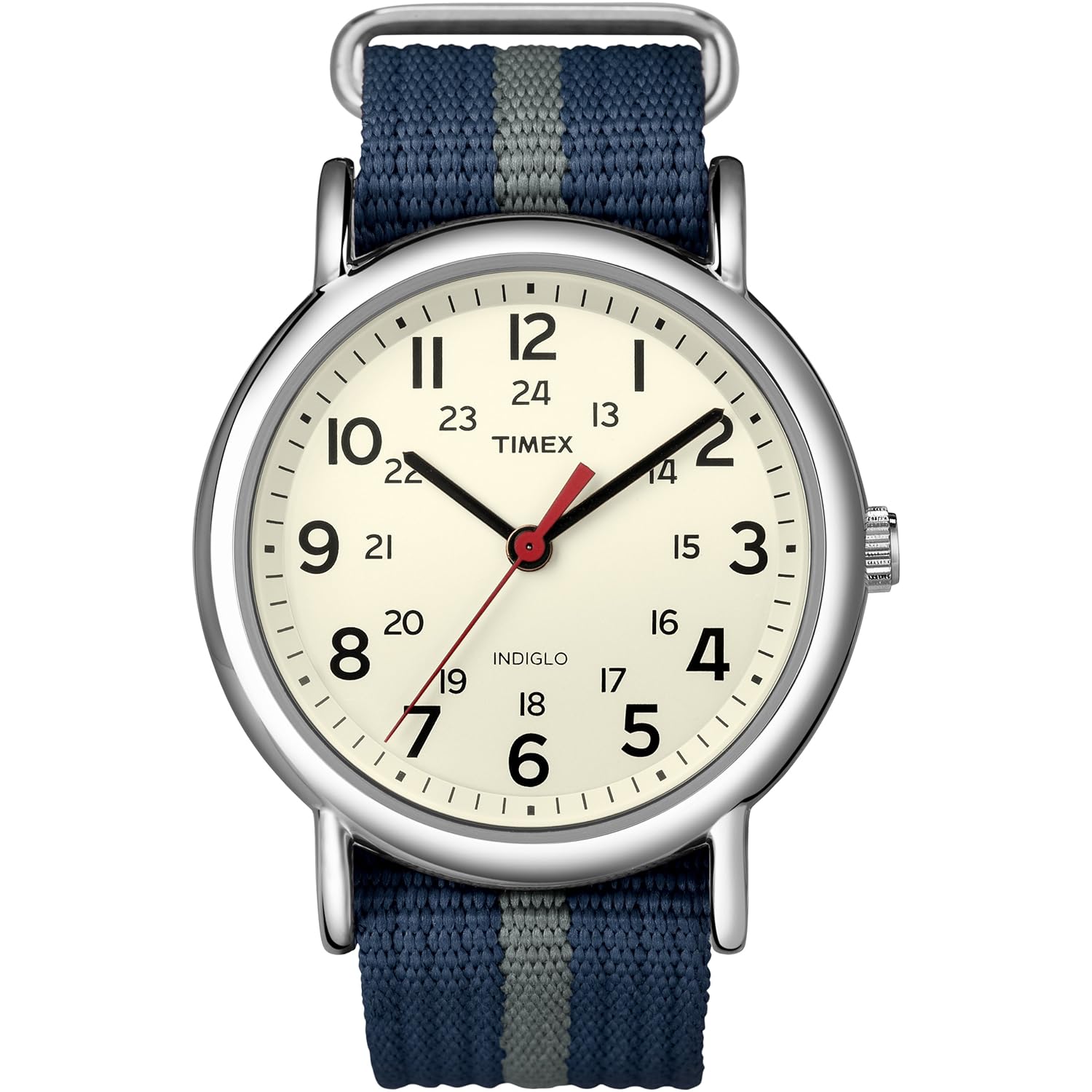
It's On Amazon: Timex Weekender Slip Through Strap Watch


As I mentioned in my Watch Primer post about affordable watches on Watches to Wear, Timex is a great, dependable brand when it comes to affordable, workhorse timepieces.  As their collaboration model with J. Crew has demonstrated - both by it's popularity and exorbitant-for-a-Timex $150 price tag - the military watch on nylon strap is a versatile and stylish combination that can look good with work attire as easily as it does with jeans and a t-shirt.  There's a line of watches available for $30 on Amazon that can fill the same niche in your watch box for only 1/5th of the price.

Pictured above is my pick of the line: the T2N654KW, with off-white face and blue/gray NATO-style strap.  Really these models are inexpensive enough that you could easily buy both the white and black dialed versions. And - though I'll have to test it myself when I receive the watch in the mail - I suspect these models would dress up quite nicely if you swapped out the NATO for a respectable leather band of the same width (which, according to Amazon, is 20mm).

Saturday, December 10, 2011

Quick Buyer's Tip: Dress Shirt Collars

Having recently tapped some of the Black Friday deals to get better-fitting items in my wardrobe, I thought I'd offer a quick tip about dress shirt collars: the farther the stitching is from the edge of the collar, the finer the quality.

Wednesday, October 19, 2011

An eBay Primer: Using the Free Market to Your Advantage (as a Buyer)


I opened my eBay account at the same time that I was learning about supply and demand curves in AP Economics. More than a decade has passed since then, but eBay remains one of the best examples I know of the raw forces of a free market system at work. The bottom line in a free market is this: the price at which an item will sell is the price at which a buyer is willing to purchase it. On eBay, however, in order for this principle to apply, there must be at least two buyers bidding on the item in question. Without the competition between at least two buyers, a given item will sell for its asking price--presuming it sells at all. Further complicating matters is the quantity of the item available for purchase. As in the classic supply-demand curve, where demand remains constant, the greater the supply, the lower the price of the good in question, because the greater the supply, the more sellers will compete against one another to attract a buyer for their items. Also, buyers may be willing to let a few auctions go in order to secure the item at a lower price if they can be relatively sure that more auctions featuring that item will be coming down the pipeline. Where the item in question is rare enough that an auction may represent the only opportunity for most buyers to acquire it, all bets are off. If the item is likely to have a dedicated following, a heated bidding will almost inevitably ensue, with the winning bidder paying top dollar for the honor of bringing home such a rare prize. Just as it takes two to tango, it takes at least two to start a bidding war. Nevertheless, I've done my part on more than one occasion, with the most egregious examples stemming from rare - and usually Japan-only - Rockman/Mega Man-related items. I paid roughly 150% MSRP on a Rockman DASH artbook during my first year on eBay, and a year ago, fought (and won) a ferocious bidding war on a garage kit Rockman model that predated (and, in terms of sculpting if not articulation, bested) the mass production model kit from Kotobukiya. I believe I paid roughly double the original price you'd have paid if you were lucky enough to attend the garage model convention at which the kit was sold, but seeing as my max bid was nearly double that amount (because it seemed to be - and to my knowledge has been - the only kit ever sold on eBay), I still enjoyed a considerable consumer surplus. So what can you learn from free market principles, bidding wars, and my Rockman fanaticism?

Know the Market, Play the Market


Whenever you conduct a search for an item, before you even place your first bid on an auction, you should refine the search parameters to show completed items only.  The results you obtain from this refinement will reveal the state of the market for that particular item.

If there have been several completed auctions in addition to several live ones, then the supply of the item in question seems pretty healthy.  If the completed items reveal that one of the sellers of the live auctions has listed the same item repeatedly in the past, then the likelihood that more of that item will be available through that seller also increases.

Determine Your Max Bid Before You Make Your Opening Bid

If a number of the completed items sold for a relatively consistent high bid, then congratulations: You've discovered the current market price for the item, which should serve as a price ceiling for your own maximum bids if you don't intend to overpay.  Often times, though, you'll find a range of high bids that vary according to random factors like the timing of the auction, the number of people who bid on the auction, and the disposition of the auction's high bidders.

If the supply seems a bit tentative, then depending on how badly you want the item, you may need to be prepared to enter a max bid a bit higher than the market price.  And if the item is virtually one-of-a-kind as far as eBay goes, and you absolutely must have it, then be prepared to enter into a bidding war and end up paying top dollar (read: potentially up to as much as you can afford) for the honor of claiming the prize as your own.

Establishing a max bid amount beforehand forces you to assess how badly you want the item in question, as well as how much money you want - or at least can afford - to sink into it in order to make it your own.  It removes the fevered adrenaline rush of raising your bid in the last few seconds of an auction - otherwise known as sniping - and the likelihood that heightened emotions get the better of you and you end up paying so much for an item that you ultimately regret having won it.  There's nothing intrinsically wrong with sniping - in fact, that'll be the topic of a future Primer post - so long as you establish your well-considered bid ceiling beforehand, and stick to it, regardless of what your adrenaline-amped sensibilities might try to convince you to do otherwise.

Saturday, October 15, 2011

An eBay Primer: The 3 Most Important Things A Buyer Should Know


This post will be the first in a series intended to provide advice for those looking to buy or sell items on eBay.  I've been using eBay for both purposes for over ten years now, and over the course of thousands of transactions I've never had a negative feedback from a buyer - or have had to give negative feedback to a seller.  eBay is an incredible resource for locating hard-to-find items or for paring down the clutter in your house, and the rules of thumb by which I've learned to operate on eBay can help anyone get on the 'Bay with the least amount of trouble.

1) Feedback Matters

Feedback scores, though far from perfect, is still one of best and most expedient ways to determine whether a seller is trustworthy enough to do business with.  And while any seller with a large score and a feedback percentage better than 98% is usually trustworthy, some of the power sellers who meet eBay's strict criteria earn "Top-Rated" seller status, which is an even stronger indication that they'll do right by you in any given transaction.  Especially when you're starting out, avoid buying items (especially large ticket ones) from sellers with less than 98% positive feedback or only a few feedback points to their name.  Not all of those who fall below 98% or are just starting out are bad sellers or out to swindle you, but those who are will have lower feedback and - possibly - a fresh account to distance themselves from past bad transactions.

eBay's feedback system is a little different than it was back when I started.  Sellers can no longer give buyers anything but positive feedback, and some users believe this creates a power disparity that helps to protect "problem" buyers who don't pay for their items or attempt to defraud the seller.  But the current feedback policy also removes the chilling effect that retaliatory seller feedback could have on a buyer when an item fails to materialize, or shows up markedly different than how it was described at auction.

Sometimes a rare item you desperately want may only be offered by a questionable seller, or the price might be incredible.  At those times, it may be useful to go deeper: look at the negative feedback that lowered the seller's score, or look at the few transactions (if any) they've already completed.  If the negative seems to be an isolated incident, or item they're selling is in line with the things they've sold successfully in the past, determine whether the item is worth the risk.  If it is, and you go for it, and the seller turns out rotten after all, then at least you'll still be covered by the next rule:

2) Know the eBay Buyer Protection Policy

If there's a golden rule to doing buying things on eBay, this is it.  eBay's Buyer Protection Policy is one of the strongest safeguards in place to protect buyers from unscrupulous sellers, but in order to use it, a buyer should be fully versed in its provisions.  It can be tedious and difficult to understand at times, but it's there for your benefit, and the better you understand it, the better it can be there to protect you when a transaction goes south.

One of the most critical provisions: eBay/PayPal only allows you to open a dispute within 45 days of your original payment for the item.  If you wait until the 46th day to open a dispute, then all your rights under the Buyer Protection Policy evaporates into thin air.  So even if your seller is begging you to give him just a few more days to resolve your issues, if the 45th day is looming near, make sure you open your dispute before then.  If the seller comes through shortly thereafter, then you can close the dispute with no harm done; but if he's just trying to make your BPP rights expire, then you'll have headed him off at the pass, and are ready to take the next steps if he doesn't make things right.

3) Search for "Completed Items" to Get a Sense of the Market

In my early years on eBay, I would often find myself getting into ridiculous bidding wars with other buyers that ended up with either them or me paying way more for the item than any rational person should.  The best safeguard against this is to do some research on how much the same item has sold for on eBay in the recent past.  Taking the same search terms but filtering the search to show "Completed Items Only" will show you all of the recent completed listings that match your terms.

You can learn several important things from these search results: How much, on average, does the item go for?  How many of this item have been sold recently (and, by extension, how likely will it be that other listings will offer this item in the future)?  Has this seller sold the same kind of item before (and would he be likely to sell another one shortly after the current listing)?  All of these factors can help you determine what a sensible high bid should be, and in that way avoid overpaying as a result of a frenzied bidding war with no clear price ceiling.

Tuesday, October 11, 2011

It's On Amazon: Iron Chef: The Official Book

In the already diverse world of food shows, Iron Chef's place is a distinctive one.  Back when Food Network was still a fledgling television channel without its current stable of celebrity chefs/cooks, it was this strange import from Japan that drew in audiences with its gladiator-like duels between culinary professionals.  Its popularity in the U.S. spawned the short-lived Iron Chef USA and the currently airing Iron Chef America, but to me no subsequent iteration has successful captured the unique entertainment value of the original Ryouri no Tetsujin.  It is one of the greatest disappointments in my life as a consumer that (as far as I know) this series has never been collected into DVD sets in either Japan or the United States.

Those who share my consternation (or just wonder where such a left-field TV show concept, even by Japanese TV standards, came from) might be interested in Iron Chef: The Official Book, which was released several years ago and is currently available as a bargain book on Amazon.


The book offers insight into the making of the Iron Chef series, with insights from the titular Iron Chefs, announcers, and production crew.  Among the enduring questions answered by the book: why, if every other voice was dubbed for U.S. audiences, was the Chairman (the inimitable Takeshi Kaga) subtitled?  If that mystery has been niggling at you for years, you'll find the answer here.